

Integrated detection, monitoring and command system
One system. Complete operational awareness.
StarDome is the AGRON system for continuous surveillance, data fusion, situation analysis, threat detection, decision support and coordination of operators and connected equipment. It runs on AGRON 1, our own software, with the AI Pilot assistant built in.
Separate devices and data streams become one system for surveillance, analysis and decision support.
Designed for naval vessels and bases, coastal sites, military and critical infrastructure, civil ports and industrial sites, and for mobile and fixed AGRON installations.
- One operational picture
- Continuous surveillance of the controlled area
- Detection and tracking of objects
- Fusion of data from different sensors
- Analysis of events and potential threats
- Decision support for operators and command
- Coordination of connected systems
- Automated monitoring and reporting
- A complete history of events
- Operation without an external internet connection
Separate systems or one StarDome.
| Separate systems | StarDome | |
|---|---|---|
| Screens | One per system | One operational picture |
| Time | Each system on its own clock | All sources on one timeline |
| Records | Scattered across recorders | One event history in the Black Box |
| New equipment | Often another separate system | Connected through an adapter |
| Without internet | Depends on each system | Local operation by design |
| Next step | Left to the operator alone | Recommended, with its reason; a person decides |
Many sources. One operational picture.
Radars, cameras, thermal imagers, RF monitoring, navigation, unmanned vehicles and external services usually work apart. Operators switch between screens and need longer to understand what is happening. StarDome brings these sources together in AGRON 1.
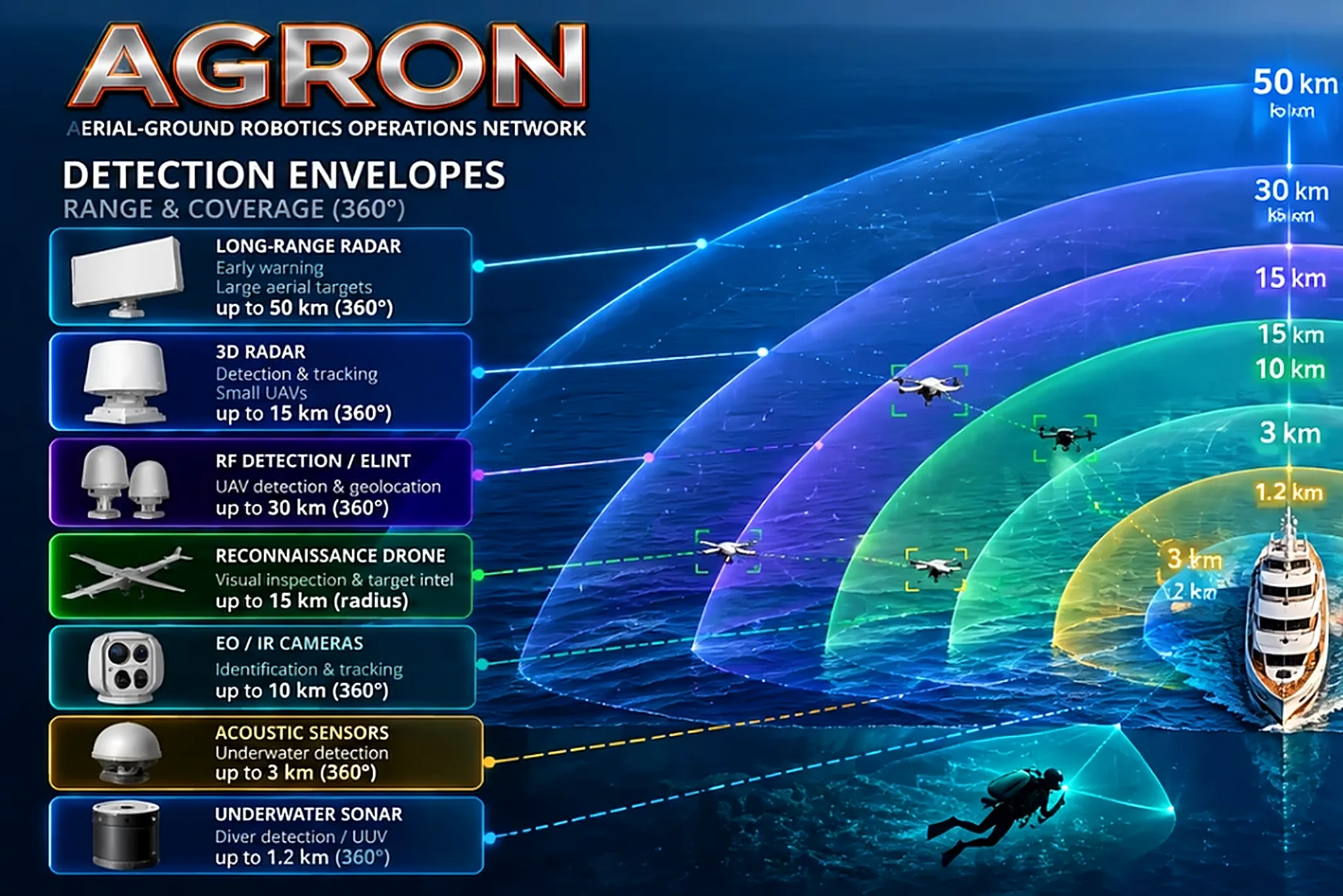
- 3D, marine and perimeter radar
- EO/IR optics
- Passive RF detection and DF
- Sonar and diver detection
- Surveillance UAV and docks
- SATCOM and cellular
- One operating pictureEvery object as a single fused track.
- Black BoxTamper-evident event log and video archive.
- Works offlineKeeps operating without a network link.
- Single map
- Objects, events, surveillance zones and connected equipment on one map.
- Fused observations
- Data from several sources is matched to give a fuller picture of each object.
- Object tracking
- Identifiers, positions, changes of state and the history of each observation are kept.
- Data confidence
- Quality, freshness and reliability of incoming data are shown, not hidden.
- Event history
- Observations, alerts and operator actions are kept in sequence.
- Role-based distribution
- Each user receives the information their authority allows.
Example: one contact, one picture
- A radar detects an object in the controlled zone.
- StarDome receives its position and movement.
- With an optical system connected, the operator matches the radar data with the camera image.
- Other sources help to refine what the object is.
- AI Pilot prepares a short summary and points out what data is still missing.
- The operator receives one combined view instead of several separate messages.
From data to decisions.
StarDome does not just display information. It turns incoming data into structured information that can be analyzed and acted on.
- 01
Data acquisition
Feeds from equipment of different manufacturers through interfaces and adapters.
- 02
Fusion
Observations are combined, taking into account time, source, coordinates, measurement error and quality.
- 03
Tracking
Each object keeps one record that is updated over time.
- 04
Analysis
Objects are classified and events are assessed against the site's security conditions.
- 05
Alerts
Each alert states its type, time, sources, priority, supporting data and status.
- 06
Decision support
The operator acknowledges, records the actions taken and sees a recommended next step.
What raises the risk level
- An object appears in the controlled zone
- A set perimeter is crossed
- An observed object behaves unusually
- Sources contradict each other
- Contact with key equipment is lost
- A sensor fails
- The state of a protected asset changes
Honest about uncertainty
When the data is not enough, StarDome shows the uncertainty instead of giving an object a category it has not earned. Stale or unreliable information is clearly marked.
AI Pilot: an assistant that knows the situation.
AI Pilot is the intelligent assistant built into StarDome. It is not a generic chat: it works with the context of the system, including equipment data, events, observation history, system status and approved documentation, and it answers in plain language, by text or voice.
What is the situation around the site right now?
Three contacts on the picture. Two are identified as known traffic. One small unmanned aircraft is classified but not identified, 200 m east, holding position. Radar, AIS and cameras are online; sonar is on standby.
Which events have not been checked yet?
One: the unmanned aircraft, raised by radar and confirmed by camera 4. Missing: RF data on its control link. Suggested step: request an additional observation.
Prepare the shift handover summary.
Summary ready: 6 events, 1 active alert, 2 equipment state changes, no open checks. Every line links to its source record and time stamp.
- Understands the situation
- Answers questions about the current picture, recent events, new alerts and equipment faults, and says plainly when information is missing.
- Analyzes
- Works across observations, alert history, equipment state, several sensors, lost links and conflicting sources, and separates confirmed facts, preliminary assessments and unknowns.
- Recommends within procedures
- Suggests steps such as checking a sensor, requesting another observation, escalating to the responsible operator or reassessing an event when new data arrives.
- Listens and speaks
- A voice interface keeps hands free, with confirmation of critical commands and separation of user rights.
- Writes reports
- Situation summaries, period reports, alert lists, event histories, equipment and fault reports, and shift handovers, each with links to source records and time stamps.
Help for every role
- Commander or site lead
- Summaries, alerts and reports.
- Surveillance operator
- Finding events, analyzing data, working the interface.
- Technical specialist
- Equipment state, faults and technical events.
- Administrator
- Services, connections and system logs, within their rights.
AI Pilot never decides on the use of weapons or the selection of targets. It reaches data only through controlled AGRON 1 interfaces, not through unrestricted access to internal systems.
How StarDome works on the site.
StarDome runs predefined scenarios for surveillance, response to events and maintenance, configured for the tasks of each site. Choose a scenario.
Site: naval base or protected water area.
- StarDome receives data from the connected surveillance equipment.
- A new object enters the controlled zone and an event is created.
- The operator sees the available data, its sources and the event history.
- AI Pilot prepares a summary and names the extra information needed to verify the contact.
- Every action is recorded in the log.
Site: military or auxiliary vessel.
- StarDome combines surveillance, navigation and the state of connected systems.
- The crew works from one shared picture.
- AI Pilot prepares summaries and finds events.
- It checks equipment state and reviews the alert history.
- Information passes cleanly from one watch to the next.
Site: military base or fixed installation.
- Observations arrive from compatible radars, optical and RF equipment.
- The data appears in one interface.
- An unidentified object triggers an alert under the configured rules.
- AI Pilot explains which sources raised the event and how complete the information is.
- Authorized personnel decide on further action.
Site: AGRON MOBILE vehicle complex.
- After deployment the operator checks the connected equipment.
- StarDome shows the availability of sensors, links and compute.
- AI Pilot walks the operator through the approved readiness checklist.
- If something fails, diagnostic information is shown.
Site: autonomous AGRON installation, external link lost.
- StarDome keeps running every local function that does not depend on external services.
- The operator is notified that the connection is lost.
- AI Pilot shows which functions remain and which external sources stopped updating.
- When the link returns, data is synchronized in a controlled way where supported.
Event: a connected sensor stops sending data.
- StarDome records the lost link and the change of device state.
- AI Pilot establishes when the failure happened and which data stopped.
- It shows which functions are affected and which checks the documentation prescribes.
- The fault history and the technicians' actions are kept.
Moment: end of a shift.
- AI Pilot prepares a structured summary.
- It lists main events, active alerts and unprocessed messages.
- It adds equipment state changes, faults and open checks.
- The next shift receives everything in one format.
Equipment of different manufacturers, one system.
Equipment connects through its interfaces, software adapters and AGRON integration services. What each model provides depends on its interfaces and data formats.
Radar
Coordinates, range, bearing, speed and course where provided, observation history and equipment status. 2D and 3D radars.
Optics
Day, PTZ and high-resolution cameras, thermal imagers and multispectral systems: video, metadata and links to events.
RF monitoring
Detected signals, frequency bands, timing, direction to the source where the equipment allows, receiver status.
Navigation
GNSS, AIS, ship navigation systems, own position, course, speed, time and synchronization.
Maritime and underwater
Sonar, hydroacoustic systems, underwater surveillance and sea-state sensors.
Unmanned systems
Position, telemetry, power, link and mission status, dock state, video and images where available.
External sources
Weather, geographic data, navigation warnings, connected information systems and messages from other services, each with a trust and freshness status.
Local operation. Controlled connectivity.
StarDome is designed to run its core software on site, without a permanent internet or mobile connection.
- Local compute servers
- Network equipment
- Local databases
- Telemetry intake
- Processing modules
- Operator interfaces
- Event storage
- Backup power
- Local processing
- Data is processed where it is collected.
- Local storage
- Information stays in the site's own infrastructure.
- Independent operation
- Local functions run without mandatory access to cloud services.
- Controlled synchronization
- Data is exchanged with external systems over authorized connections only.
- Operational continuity
- Local functions stay available when the external link is disrupted.
Offline operation of AI Pilot, voice and individual analytical functions is confirmed for each hardware and software configuration.
Unmanned systems on the same picture.
StarDome integrates compatible unmanned systems of different manufacturers: aerial, surface, ground and underwater vehicles, and automated docking stations.
Information received: device ID, coordinates, telemetry, power, link status, equipment state, video, error messages and dock state.
AGRON 1 provides unified interfaces for connecting external systems. Control functions are developed separately for each integration, based on the confirmed capabilities of the equipment, access rights and safety requirements. Receiving telemetry, controlling equipment and autonomous task execution are always distinguished.
Every component, watched.
StarDome monitors the technical state of integrated components where interfaces allow: device availability, connections, compute nodes, system errors, resource use, storage, temperatures, power, communication links and software services.
AI Pilot for the technical team
- Finds faults and analyzes logs
- Explains error messages
- Checks the sequence of events
- Finds the relevant documentation
- Writes technical reports
What each team gains.
Command
- One view of the situation
- Structured reports
- Event history
- Decision support
Operators
- Fewer separate interfaces
- Combined information
- Alerts in context
- Help from AI Pilot
Technicians
- Equipment monitoring
- Diagnostic information
- Fault history
- Maintenance support
Organization
- One way of working with all equipment
- Integration of different manufacturers
- Software that keeps developing
- Several deployment options
Find your StarDome configuration.
Answer three questions and see an indicative configuration. The final composition is defined by the technical design for your site.
StarDome C20 Base
Sensor suiteAGRON 1 · AI Pilot · Black Box · local operation
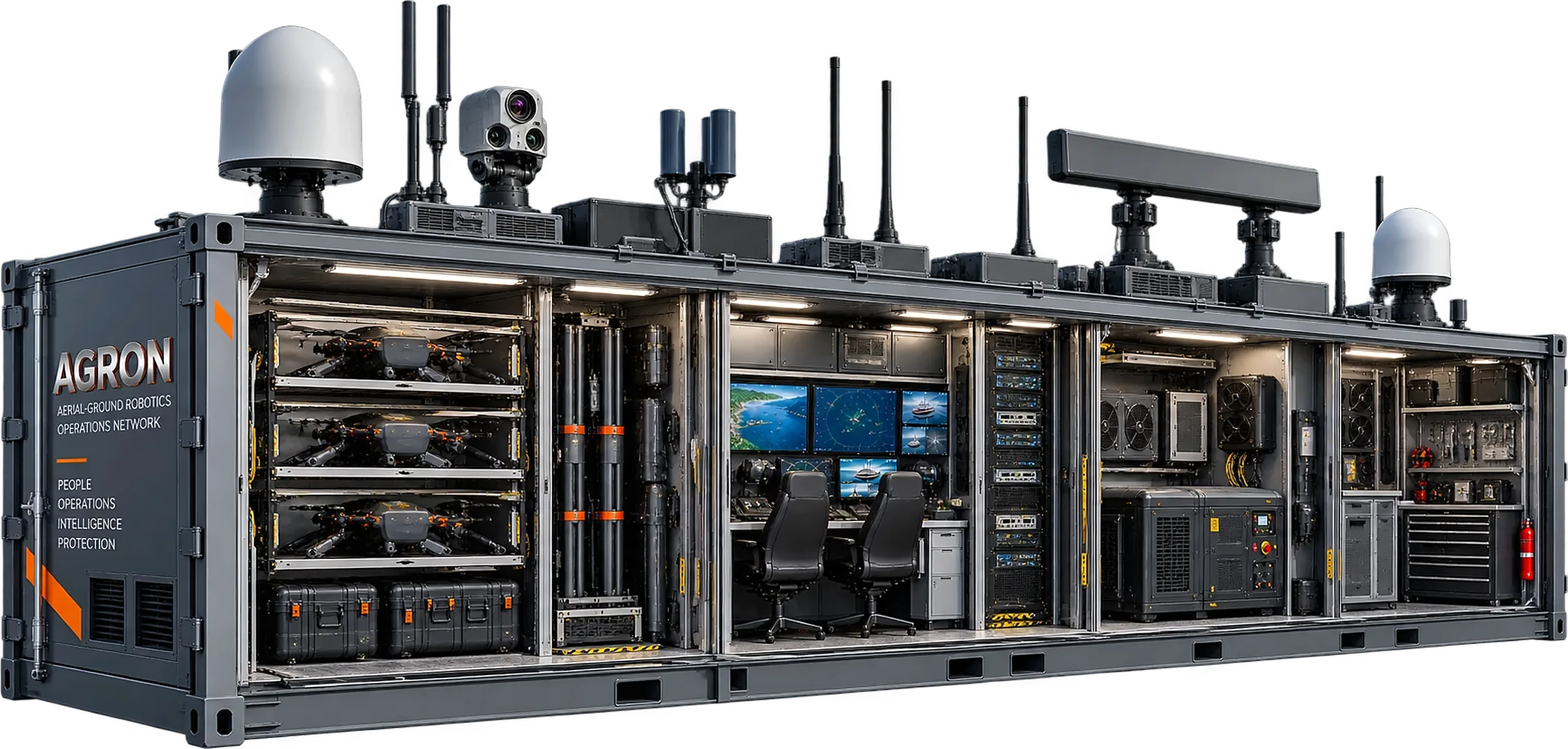
A complete station inside a shipping container.
StarDome runs in containerized, mobile, fixed and maritime configurations. The exact equipment and functions are defined by the technical design for each site.
- AGRON C20
- Container station with local compute and integrated equipment.
- AGRON C40
- Extended container configuration for tasks that need more space and equipment.
- AGRON MOBILE
- Mobile version with local compute and connected systems.
- Fixed installations
- Permanent installation at bases, facilities and infrastructure sites.
- Maritime installations
- Integration with compatible ship and shore systems.
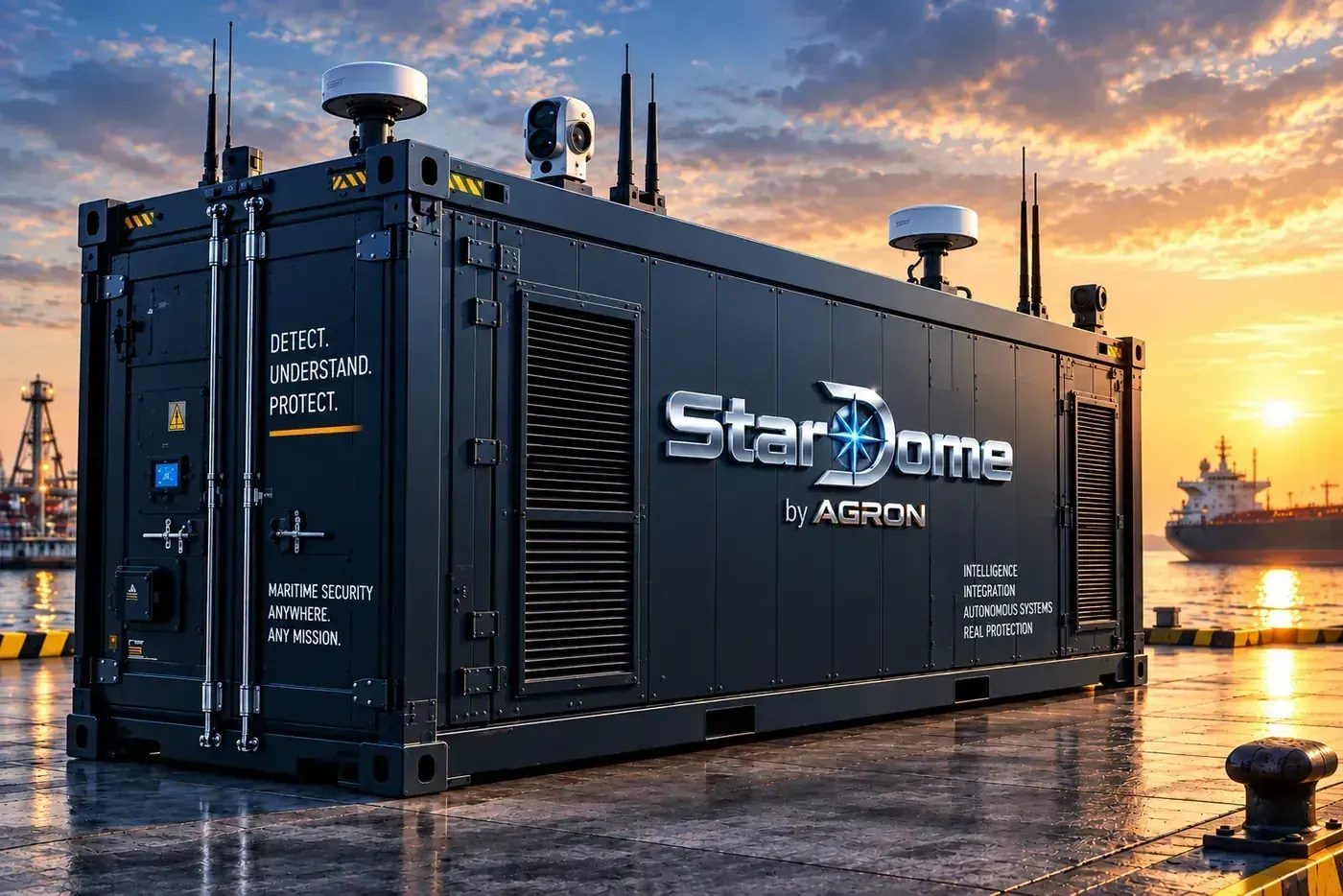
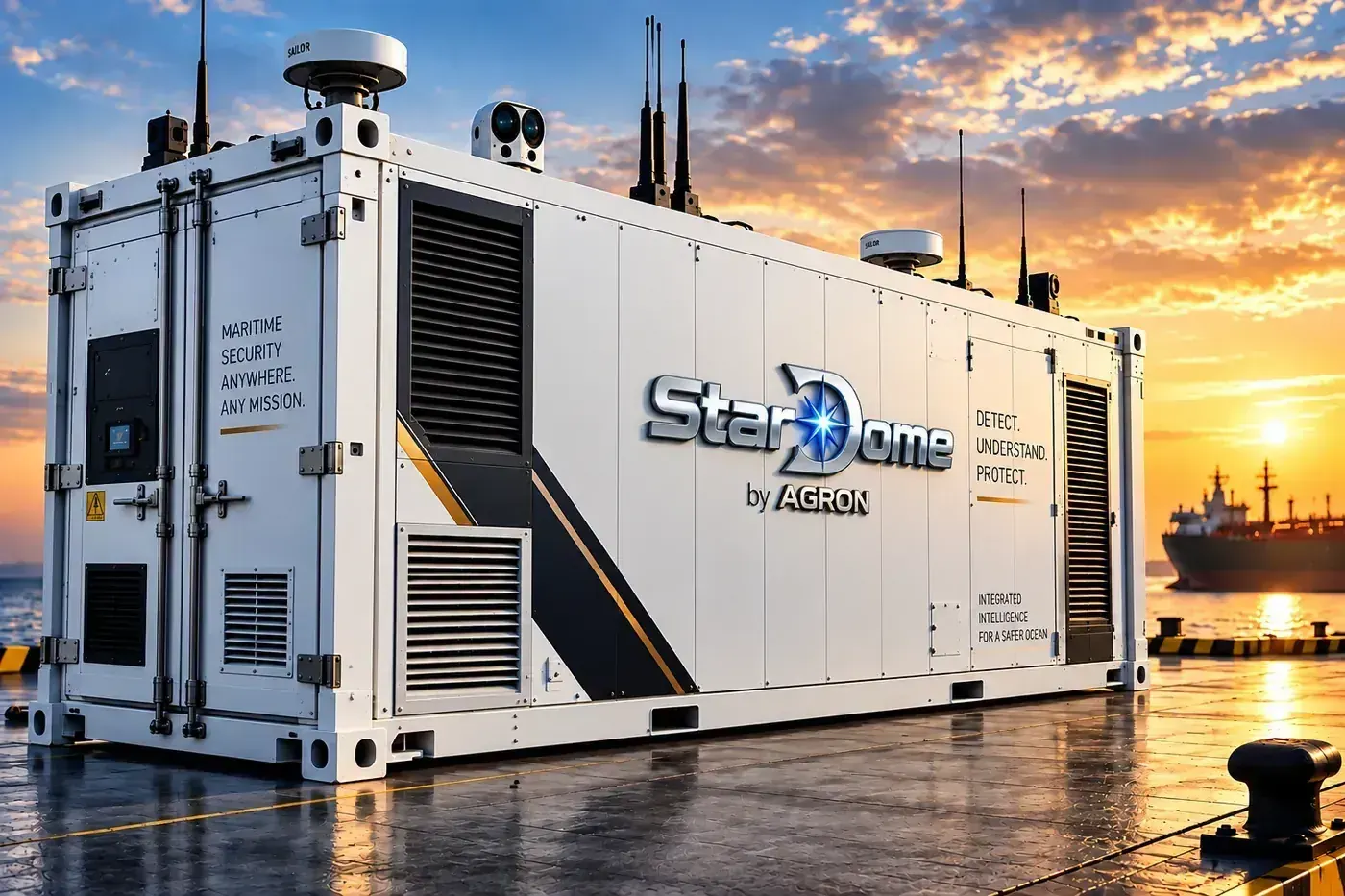
- 01Radar
- 02EO/IR turret
- 03UAV dock
- 04Passive RF / DF array
- 05SATCOM
- 06Compute and power bay
| Configuration | Platform | Unmanned | Status |
|---|---|---|---|
| StarDome C20 Base | 20 ft | — | On request |
| StarDome C20 Enhanced | 20 ft | Up to 6 surveillance UAV | In design |
| StarDome C40 Base | 40 ft | — | On request |
| StarDome C40 Advanced | 40 ft | Up to 12 UAV | In design |
| StarDome C40 HQ | 40 ft | — | On request |
Every configuration keeps expansion bays for additional sensors. Specifications, pricing and lead times on request.
Request the specification · StarDome C20Request the specification · StarDome C40
Adapted to your equipment and your site.
AGRON engineers adapt StarDome to the equipment and infrastructure the customer already has: new adapters for existing sensors, integration with ship and shore systems, site-specific scenarios and alert rules. The AGRON 1 architecture lets individual components evolve without replacing the whole system.
The functions described on this page depend on configuration and connected equipment. Each proposal states which functions are available today, which integrations are confirmed and which capabilities are in development.
Container or vehicle. The same StarDome.
AGRON C20, C40 and AGRON MOBILE run the same StarDome software and give the operator the same picture, whether the site is a port berth, a marina or a temporary perimeter.
AGRON C20AGRON C40AGRON MOBILE